Current issue
Author:Dagin Lin*、Yuling Lin、Yiwen Wang、Ssuyu Lin、Chengbin Li、 Weichen Wen Jau-Yueh Wang3, Chang-Sheng Wang6, and Shu Chen7
Abstract:
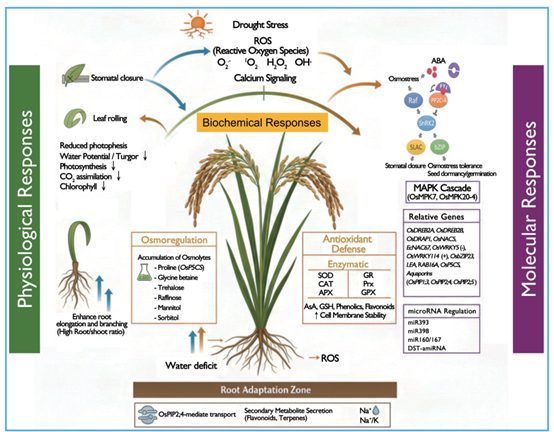
Rice, a water-demanding staple crop, faces escalating risks from climate change and freshwater scarcity, making improved drought resilience essential for food security and sustainable agriculture. This review synthesizes physiological, biochemical, and molecular responses of rice to drought, emphasizing actionable avenues for breeding. Core adaptive processes include osmotic adjustment, reactive oxygen species (ROS) detoxification, stomatal regulation, and remodeling of root system architecture. Advances from quantitative trait locus (QTL) mapping and gene cloning have identified drought-associated regions and genes- such as the qDTY series (e.g., qDTY1.1), qDTR8, qDLR8.1, and candidate genes including OsNAC5, OsCPK9, and LEA proteins, that provide valuable genetic resources for marker-assisted improvement. Small-RNA regulation constitutes an additional control layer: over 30 drought-responsive microRNAs have been reported, with at least 19 showing defined functions; exemplars include miR393, miR398, miR160, miR167, and DST-amiRNA, which modulate auxin signaling, antioxidative capacity, and stomatal dynamics. On the application front, marker-assisted selection and QTL pyramid have delivered drought-tolerant lines and cultivars. Nevertheless, field expression and precise quantification of drought-related traits remain major bottlenecks that constrain genetic gain. Future progress will hinge on integrating high throughput phenomics with genomic and epigenomic information and contextual environmental data to build multi-level regulatory networks and robust, multidimensional selection indices. Such integrative pipelines are expected to accelerate the development and deployment of drought-resilient rice varieties, advancing the intelligent and sustainable transformation of crop production systems.
Key words:Rice, Drought tolerance, Quantitative trait locus (QTL), Candidate gene, Molecular breeding
Download: OTHER FORMAT Links
Taiwan Agricultural Research
 ISSN: 2790-086X
Vol. 75, No.3 (2026)
ISSN: 2790-086X
Vol. 75, No.3 (2026)
 Submit your manuscript
 Guide for authors
- 1. Effects of Fertilizer Application Rates on the Growth and Functional Components of Chrysanthemum morifolium (‘Taiwan Hangju No. 1’)
- 2. Biological Functions, Antioxidant Properties, and Environmental Regulation of Plant Phenolic Compounds
- 3. Comparative Study of Asparagus Cultivars under Greenhouse Conditions