Current issue
Author:Chuping Lin、Chiaowen Huang1、Jinhsing Huang、Jyhnong Tsai、 Minchi Hsu*
Abstract:
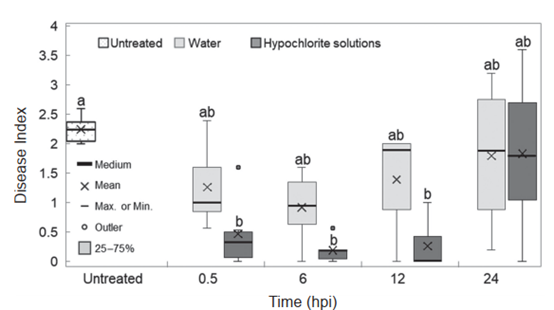
Pitaya (Hylocereus spp.) is an economically important fruit crop, and wet rot disease caused by Gilbertella persicaria has become a major concern to the industry. This study aimed to evaluate the efficacy of hypochlorite solution (pH 8.1–8.4) in controlling postharvest wet rot disease of pitaya fruit. In an in vitro assay, hypochlorite solution with available chlorine concentrations up to 200 mg L-1 didn’t significantly inhibit mycelial growth of G. persicaria. In contrast, spore germination was effectively suppressed at concentrations above 150 mg L-1. Further artificial inoculation tests using fruits of white-fleshed pitaya cultivar revealed that postharvest treatment with 200 mg L-1 hypochlorite solution for 30–60 s significantly reduced the disease index (rated on a 0–4 scale based on the diseased area) of wet rot disease. Evaluations of treatment timing indicated that application within 12 h after inoculation significantly reduced the disease index, whereas treatments applied after 24 h showed no significant difference compared with the untreated control. Notably, with the same treatments, no protective effect was observed on red-flesh pitaya cultivar artificially inoculated with the pathogen. Postharvest treatments of naturally infected fruits under field conditions revealed that application of hypochlorite solution containing 200 mg L-1 chlorine reduced the average disease incidence of wet rot in white-flesh pitaya from 43.0 ± 6.5% in untreated fruits to 9.4 ± 4.5%, achieving a control efficacy of 79.0 ± 11.3%. In contrast, the same treatment unexpectedly increased disease incidence in red-flesh pitaya, with the average incidence rising from 43.0 ± 20.8% in untreated fruits to 69.2 ± 13.9%. Overall, fruit postharvest treatment with hypochlorite solution effectively reduces wet rot disease index in white-fleshed cultivar, however, alternative management strategies are required for red-fleshed cultivars.
Key words:Gilbertella persicaria, Postharvest treatment, Optimal concentration and duration, Timing of treatment
Download: OTHER FORMAT Links
Taiwan Agricultural Research
 ISSN: 2790-086X
Vol. 75, No.3 (2026)
ISSN: 2790-086X
Vol. 75, No.3 (2026)
 Submit your manuscript
 Guide for authors
- 1. Effects of Fertilizer Application Rates on the Growth and Functional Components of Chrysanthemum morifolium (‘Taiwan Hangju No. 1’)
- 2. Biological Functions, Antioxidant Properties, and Environmental Regulation of Plant Phenolic Compounds
- 3. Comparative Study of Asparagus Cultivars under Greenhouse Conditions