Current issue
Author:Tzuhuan Hung、Chiuhua Chen、Chiahua Chang、Yalin Lee、Yungming Yeh、Tsaili Kung、Cheng Huang
Abstract:
Mesona chinensis Benth. water extracts (MWE) have traditionally been used in Taiwan for health-promoting purposes, yet the comparative bioactivities of major cultivars remain unclear. This study examined four representative cultivars: ‘Taoyuan No. 1’ (‘TY1’), ‘Taoyuan No. 2’ (‘TY2’), ‘TARI No. 1’ (‘TN1’), and ‘Shuishang’ (‘SS’), to compare their total phenolic content (TPC), total
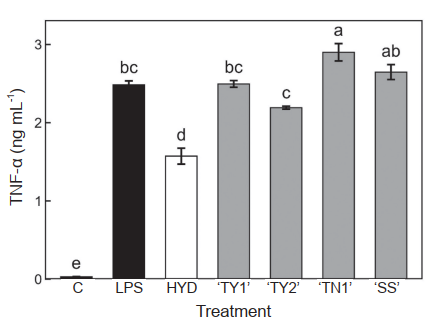
flavonoid content (TFC), antioxidant capacity, and anti-inflammatory effects. Among them, ‘TY2’ exhibited the highest TPC, TFC, and antioxidant capacity, followed by ‘TY1’, whereas ‘TN1’ and ‘SS’ showed lower levels. All water extracts were non-cytotoxic to RAW264.7 macrophages at concentrations up to 500 µg mL-1 and slightly enhanced cell viability. All cultivars significantly suppressed lipopolysaccharide (LPS)-induced nitric oxide (NO) production, and the degree of inhibition roughly corresponded with their antioxidant capacity. In contrast, TNF-α and IL-6 levels
were not significantly affected, and mild elevations were observed in some cultivars. Collectively, these findings demonstrate that MWE possess NO-suppressing anti-inflammatory potential. This study provides a comparative framework for identifying cultivars with superior functional characteristics and future value in functional food development.
Key words:Mesona chinensis water extract, Antioxidant, Nitric oxide, TNF-α, IL-6
Download: OTHER FORMAT Links
Taiwan Agricultural Research
 ISSN: 2790-086X
Vol. 75, No.3 (2026)
ISSN: 2790-086X
Vol. 75, No.3 (2026)
 Submit your manuscript
 Guide for authors
- 1. Effects of Fertilizer Application Rates on the Growth and Functional Components of Chrysanthemum morifolium (‘Taiwan Hangju No. 1’)
- 2. Biological Functions, Antioxidant Properties, and Environmental Regulation of Plant Phenolic Compounds
- 3. Comparative Study of Asparagus Cultivars under Greenhouse Conditions