Current issue
Author:Hsiou-Hua Hao、Yaw-Jen Dong*、Pei-Chen Hsu、Chi-Feng Lee、Hsien-Tzung Shih
Abstract:
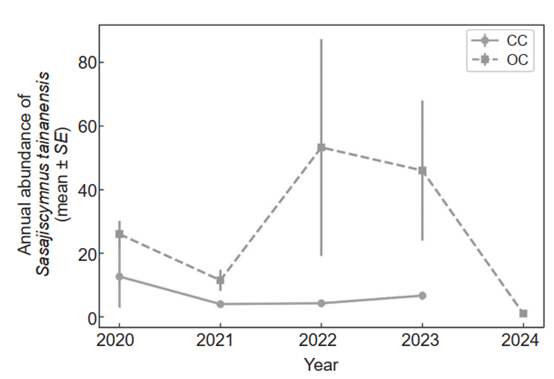
Enhancing our understanding of how lady beetle biodiversity responds to organic and conventional farming is essential for sustainable pest management in tropical fruit systems. This study aims to compare the composition and interannual variation of lady beetle assemblages across different farming practices to assess the long-term differences in natural enemy assemblages in tropical orchards under organic and conventional management. From 2020 to 2024, lady beetle
assemblages were surveyed in organically cultivated (OC) and conventionally cultivated (CC) Indian jujube orchards in Yanchao, Kaohsiung. A total of 20 species were recorded in OC orchards and 11 species in CC orchards. Sasajiscymnus tainanensis was the dominant species in both systems, and several species, including Cheilomenes sexmaculata and Cryptogonus orbiculus, were more abundant in OC orchards. The mycophagous species Illeis koebelei occurred exclusively in OC orchards.
Mean species richness and total abundance per survey were significantly higher in OC orchards (P < 0.05 for both metrics). Shannon diversity was significantly greater in OC orchards, whereas Berger-Parker dominance did not differ between systems. Annual total abundance was consistently higher in OC orchards, with a significant OC-CC difference detected only in 2021. Temporal variability at the community level was higher in OC orchards (coefficient of variation; CV = 0.753) than in CC
orchards (CV = 0.424), indicating lower interannual stability under organic management, reflecting the natural response of the population to changes in prey resources under low pesticide disturbance. These results provide multi-year empirical evidence of distinct community patterns of lady beetles under different farming systems in subtropical fruit orchards, which can serve as a basis for ecological monitoring and planning pest management strategies.
Key words:Coccinellidae, Biological control, Predator assemblages, Agricultural intensification, Ecosystem services
Download: OTHER FORMAT Links
Taiwan Agricultural Research
 ISSN: 2790-086X
Vol. 75, No.3 (2026)
ISSN: 2790-086X
Vol. 75, No.3 (2026)
 Submit your manuscript
 Guide for authors
- 1. Effects of Fertilizer Application Rates on the Growth and Functional Components of Chrysanthemum morifolium (‘Taiwan Hangju No. 1’)
- 2. Biological Functions, Antioxidant Properties, and Environmental Regulation of Plant Phenolic Compounds
- 3. Comparative Study of Asparagus Cultivars under Greenhouse Conditions