Current issue
Author:Ming-Yao Chiang、Shu-Chen Chang*、Hsuan Shentu1、Xin-Yi Tsai、Shu-Ming Chang、Chia-Yin Ku、Chung-Min Yang
Abstract:
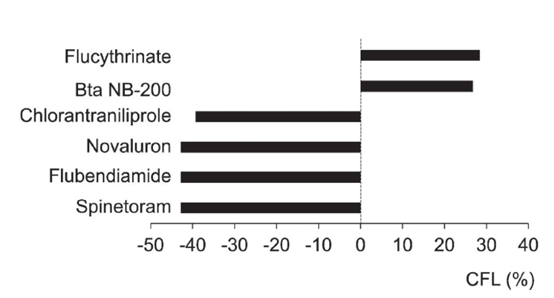
Fall armyworm (FAW), Spodoptera frugiperda, invaded Taiwan in 2019 and rapidly became a major pest of maize and sorghum. This study evaluated the susceptibility of field populations from different regions and years to various chemical insecticides- including organophosphates, pyrethroids, neonicotinoids, spinosyns, diamides, and insect growth regulators- and two Bacillus thuringiensis (Bt) formulations. At the time of invasion, the FAW population exhibited significant differences in susceptibility to the tested insecticides. Based on control failure likelihood (CFL) values at recommended concentrations, spinetoram, flubendiamide, novaluron, and chlorantraniliprole posed a negligible risk of control failure, whereas Bt subsp. aizawai (Bta) NB-200 and flucythrinate presented a high risk. Comparisons of FAW populations collected from mainland Taiwan in 2019 and 2023 showed significantly lower LC50 values for chlorantraniliprole and novaluron, but a significantly higher LC50 for Bta ABTS-1857, in the 2023 populations. In contrast, susceptibility to etofenprox, spinetoram, and Bta NB-200 did not change significantly. After 38 laboratory generations without insecticide exposure, the laboratory-maintained YY progeny showed a marked recovery of susceptibility to flubendiamide and chlorantraniliprole, with LC50 values decreasing by 9.76- and 201.91-fold, respectively. These findings highlight the importance of insecticide selection pressure in FAW resistance dynamics and are consistent with integrated pest management approaches that involve insecticide rotation and the temporary withdrawal of compounds showing elevated resistance.
Key words:Fall armyworm, Insecticide resistance, Diamide insecticides, Control failure likelihood, Integrated pest management
Download: OTHER FORMAT Links
Taiwan Agricultural Research
 ISSN: 2790-086X
Vol. 75, No.3 (2026)
ISSN: 2790-086X
Vol. 75, No.3 (2026)
 Submit your manuscript
 Guide for authors
- 1. Effects of Fertilizer Application Rates on the Growth and Functional Components of Chrysanthemum morifolium (‘Taiwan Hangju No. 1’)
- 2. Biological Functions, Antioxidant Properties, and Environmental Regulation of Plant Phenolic Compounds
- 3. Comparative Study of Asparagus Cultivars under Greenhouse Conditions