Current issue
Author:Chia-Hsin Tsai、Shu-Ling Hwang、Mei-Ju Lin、Chiao-Yu Ku、 Ting-Hsuan Hung*
Abstract:
In 2014, tomato plants grown in a field located in the Waipu District, Taichung City, Taiwan,
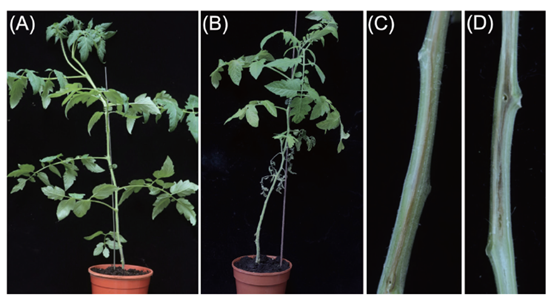
exhibited stunted growth and increased fruit abscission. Affected plants exhibited epidermal browning
on the stems, and longitudinal sections of the stem revealed browning of the vascular bundles.
Microscopic examination of the symptomatic stem tissues revealed abundant bacterial presence,
indicating a bacterial infection. On nutrient agar, colonies of Pectobacterium carotovorum subsp.
carotovorum, the known causal agent of bacterial soft rot, was isolated from symptomatic stem
tissues. In addition, the unknown yellowish bacteria were also isolated. The yellowish bacteria were
identified as Pseudomonas corrugata based on the Biolog identification system, physiological and
biochemical characterizations, polymerase chain reaction (PCR) amplification using species-specific
primer sets, and bacterial gene sequence analysis. Pathogenicity tests were conducted by inoculating
the bacterial isolates into healthy tomato plants, which subsequently developed vascular bundle
browning extending longitudinally along the stem, resembling the symptoms observed in the field.
In cases of severe infection, pith necrosis was also observed. The same bacteria were successfully reisolated
from the symptomatic tissues, thereby fulfilling Koch’s postulates. This is the first report of P.
corrugata infection on tomato in Taiwan. To manage the disease, an in vitro screening of commercial
agrochemicals was conducted. Streptomycin, streptomycin + tetracycline, and thiophanate methyl
+ streptomycin produced distinct inhibitory zones against bacterial growth. Afterwards, no further
tomatoes were planted in the field, and the disease did not recur.
Key words:Tomato, Pith necrosis, Pseudomonas corrugate, Agrochemical screening
Download: OTHER FORMAT Links
Taiwan Agricultural Research
 ISSN: 2790-086X
Vol. 75, No.3 (2026)
ISSN: 2790-086X
Vol. 75, No.3 (2026)
 Submit your manuscript
 Guide for authors
- 1. Effects of Fertilizer Application Rates on the Growth and Functional Components of Chrysanthemum morifolium (‘Taiwan Hangju No. 1’)
- 2. Biological Functions, Antioxidant Properties, and Environmental Regulation of Plant Phenolic Compounds
- 3. Comparative Study of Asparagus Cultivars under Greenhouse Conditions