Current issue
Author:Cheng-Yu Tsai、Shiang-Shiuan Yu、Yun-Sheng Lu*
Abstract:
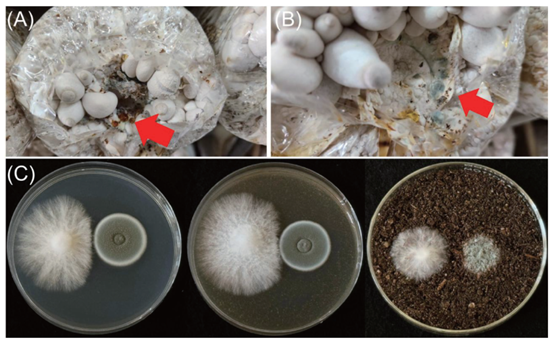
King oyster mushroom (Pleurotus eryngii (DC.) Quél.) is a commercially important cultivated mushroom in Taiwan with annual yield of 26,000 Mg and market value about 2 billion NTD. The major production areas include Taichung and Changhua. In 2024, abnormal symptoms were observed during the development of P. eryngii fruiting bodies in Xinshe, Taichung. An unidentified fungus caused mycelium of P. eryngii turn brown and produced brown exudate. The yield and quality were also affected. Signs of green mold were observed on the surface of P. eryngii mycelium. This study isolated a fungus (designated TARI-PeP01) from the signs and conducted dual culture assays with P. eryngii mycelium. Results showed that P. eryngii significantly reduced mycelial extension toward TARI-PeP01 on potato dextrose agar (PDA) and malt extract agar (MEA). It suggested that TARIPeP01 had effect on mycelium of P. eryngii. Microscopic examination showed that conidiophores of TARI-PeP01 are 155–203 μm in length, biverticillate, and bear 3–5 metulaes per branch. Each metula carries 3–5 ampulliform phialides that produce transparent, oval to round conidia. Based on morphological characteristics and internal transcribed spacer (ITS) sequence-based phylogenetic analysis, TARI-PeP01 was identified as Penicillium sumatraense Svilv. Temperature assays on PDA, MEA and sawdust medium showed that TARI-PeP01 can grow at 16–28℃, with optimal growth at 28℃. However, mycelial growth was significantly inhibited at 32℃. A fungicide sensitivity assay was performed to develop potential control strategies. The results revealed that 50% prochlorazmanganese wettable powder (WP) with 2,000-fold dilution and 35% prochloraz emulsifiable concentrate (EC) with 5,000-fold dilution inhibited 32.16% and 24.43% mycelial growth of TARIPeP01, respectively. These two fungicides with 1,000-fold dilution showed significant inhibitory effect on mycelial growth, suggesting their potential as control agents. This study is the first report of identification and control of P. sumatraense isolated from mycelium of king oyster mushroom. The selected fungicides provide promising options for this fungus management. Future work will focus on the physiological effects of P. sumatraense on P. eryngii and further investigation into the impact of other Penicillium on the mushroom industry.
Key words:Penicillium, King oyster mushroom, Prochloraz
Download: OTHER FORMAT Links
Taiwan Agricultural Research
 ISSN: 2790-086X
Vol. 75, No.3 (2026)
ISSN: 2790-086X
Vol. 75, No.3 (2026)
 Submit your manuscript
 Guide for authors
- 1. Effects of Fertilizer Application Rates on the Growth and Functional Components of Chrysanthemum morifolium (‘Taiwan Hangju No. 1’)
- 2. Biological Functions, Antioxidant Properties, and Environmental Regulation of Plant Phenolic Compounds
- 3. Comparative Study of Asparagus Cultivars under Greenhouse Conditions