Current issue
Author:Yau-Shian Tsai、Wei-Min Siang、Yu-Cheng Ko、Jer-Way Chang*
Abstract:
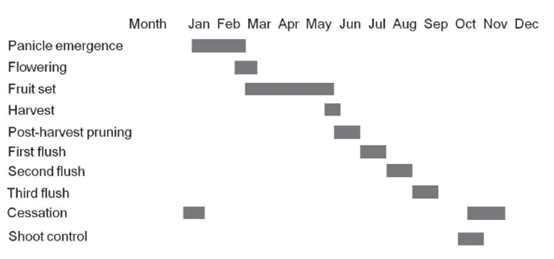
Based on a soil survey of the litchi experimental orchard at the Chiayi Agricultural Experiment Branch, it was observed that the root system of lychee trees can reach depths of over 120 cm, while the primary absorbing roots are concentrated in the 0–60 cm soil layer; consequently, this study used the 60 cm soil profile as the basis for measuring soil matric potential and water content, calculating the field capacity and permanent wilting point to be 212.26 mm and 141.52 mm, respectively, which determined the total available water to be 70.74 mm, and by applying a depletion coefficient of 0.6, the readily available water was estimated at 42.44 mm, which, when divided by an irrigation efficiency of 0.85, resulted in a gross irrigation requirement of 49.93 mm per application. Furthermore, the crop coefficients were set at 0.4 for the terminal bud period and flower bud differentiation period (November to February), 0.9 for the reproductive growth period (March to June), and 0.7 for the vegetative growth period (July to October), and by using meteorological data from the Chiayi Agricultural Experiment Branch to estimate the reference evapotranspiration, the water requirements for each growth stage were determined to be 150 mm and 140 mm for the terminal bud period and flower bud differentiation period, 552 mm and 567 mm for the reproductive growth period, and 421 mm and 423 mm for the vegetative growth period in 2023 and 2024 respectively, allowing for the formulation of an irrigation schedule based on the effective irrigation water per application, the evapotranspiration of each growth period, and monthly cumulative rainfall data.
Key words:Litchi, Irrigation schedule, Water management
Download: OTHER FORMAT Links
Taiwan Agricultural Research
 ISSN: 2790-086X
Vol. 75, No.3 (2026)
ISSN: 2790-086X
Vol. 75, No.3 (2026)
 Submit your manuscript
 Guide for authors
- 1. Effects of Fertilizer Application Rates on the Growth and Functional Components of Chrysanthemum morifolium (‘Taiwan Hangju No. 1’)
- 2. Biological Functions, Antioxidant Properties, and Environmental Regulation of Plant Phenolic Compounds
- 3. Comparative Study of Asparagus Cultivars under Greenhouse Conditions