Current issue
Author:Ya-Lin Lee*、Tzu-Huan Hung、Wei-Ting Liu、Su-Yue Lin、Yi-Han Ho、Ying-Fu Lee
Abstract:
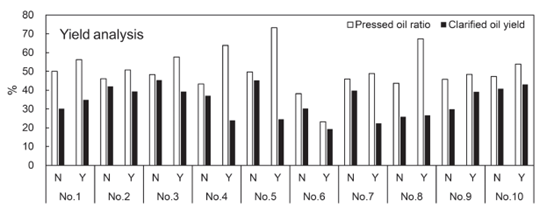
Sacha Inchi oil (Plukenetia volubilis L.), rich in ω-3 fatty acids and vitamin E, has attracted growing global interest for its potential health benefits. However, its low oxidative stability remains a key limitation to commercial application. This study investigated the effects of moderate thermal pre-treatment (roasting) on the chemical composition, oxidative stability, and functional bioactivity of Sacha Inchi oil, comparing oils extracted from roasted and unroasted seeds. Ten seed samples were collected from six regions in Taiwan: Taichung, Changhua, Nantou, Chiayi, Tainan, and Hualien. After dehulling, the seeds were mechanically pressed without intentional heating to obtain oil. Analytical parameters included acid value (AV), peroxide value (POV), oil stability index (OSI, at 130℃), vitamin E content, fatty acid profile, phospholipid composition (via thin-layer chromatography), total phenolic content, reducing power, and anti-inflammatory activity assessed using a cell-based model. Results showed that roasting did not alter the fatty acid profile or vitamin E content, but significantly improved oxidative stability (higher OSI) and promoted the accumulation of bioactive compounds such as phospholipids (ex. phosphatidylethanolamine; PE) and total phenolics, along with stronger reducing power. Both roasted and unroasted oils exhibited anti-inflammatory activity, with roasted oil showing a slightly greater suppression of nitric oxide (NO) production in lipopolysaccharide (LPS)-stimulated macrophages. In summary, controlled roasting effectively enhances the oxidative stability, bioactive composition, and physiological functionality of Sacha Inchi oil while preserving its core nutritional profile (rich in ω-3 fatty acids and vitamin E). These findings support roasting as a feasible strategy to enhance the stability and bioactivity of Sacha Inchi oil for food and nutraceutical applications.
Key words:Sacha Inchi oil, Roasting, Oxidative stability, Functional bioactivity, Anti-inflammatory activity
Download: OTHER FORMAT Links
Taiwan Agricultural Research
 ISSN: 2790-086X
Vol. 75, No.3 (2026)
ISSN: 2790-086X
Vol. 75, No.3 (2026)
 Submit your manuscript
 Guide for authors
- 1. Effects of Fertilizer Application Rates on the Growth and Functional Components of Chrysanthemum morifolium (‘Taiwan Hangju No. 1’)
- 2. Biological Functions, Antioxidant Properties, and Environmental Regulation of Plant Phenolic Compounds
- 3. Comparative Study of Asparagus Cultivars under Greenhouse Conditions