Current issue
Author:Chiou-Fang Liu、Yu-Jen Chen、Chih-Chun Kuo、Iou-Zen Chen*、Yu-Sen Chang*
Abstract:
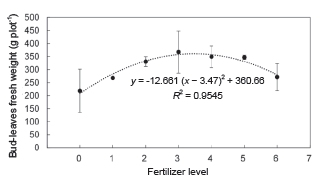
This study aimed to evaluate the effects of different fertilization levels on the growth, yield, and functional components of Chrysanthemum morifolium Ramat. cv. ‘Taiwan Hangju No. 1’. A randomized complete block design (RCBD) with seven fertilization treatments and 3 replications was employed. Nitrogen application rates were 0, 75, 150, 225, 300, 375, and 450 kg ha-1. The results indicated that plant height and canopy width increased with fertilization rates; however, excessive fertilization (level 6) significantly reduced plant survival rates to 47–60%. Quadratic regression analysis showed that maximum fresh weights of bud-leaves and flowers were achieved at fertilization levels of 3.47 and 2.75, respectively. Regarding functional components, moderate fertilization (levels 2–3) significantly enhanced the contents of total free amino acids (FAA), total polyphenols (TPP), total flavonoids (TF), and caffeoylquinic acids (CQAs) in both bud leaves and flowers, whereas excessive fertilization suppressed the accumulation of secondary metabolites. Based on an integrated evaluation of yield and quality, fertilization levels of 2–3 are recommended for this variety. During the vegetative growth stage (May–August), a total of 450–675 kg ha-1 of compound fertilizer (N-P2O5-K2O = 20-5-10) is suggested, whereas 400–600 kg ha-1 of compound fertilizer (N-P2O5-K2O = 15-15-15) is recommended during the reproductive stage (September–October). Fertilizer application rates should increase from 100–150 kg ha-1 month-1 in 50–75 kg ha-1 month-1 increments as plant growth progresses, and reach 200–300 kg ha-1 month-1 when plant growth shows no further significant increase. These fertilizer application rates effectively balance economic yield and medicinal quality.
Key words:Chrysanthemum, Fertilizer, Functional compounds
Download: OTHER FORMAT Links
Taiwan Agricultural Research
 ISSN: 2790-086X
Vol. 75, No.3 (2026)
ISSN: 2790-086X
Vol. 75, No.3 (2026)
 Submit your manuscript
 Guide for authors
- 1. Effects of Fertilizer Application Rates on the Growth and Functional Components of Chrysanthemum morifolium (‘Taiwan Hangju No. 1’)
- 2. Biological Functions, Antioxidant Properties, and Environmental Regulation of Plant Phenolic Compounds
- 3. Comparative Study of Asparagus Cultivars under Greenhouse Conditions