Current issue
Author:Chia-Hsun Ho、Man-Hsia Yang、Chiao-Ling Hsiao、Huey-Ling Lin*
Abstract:
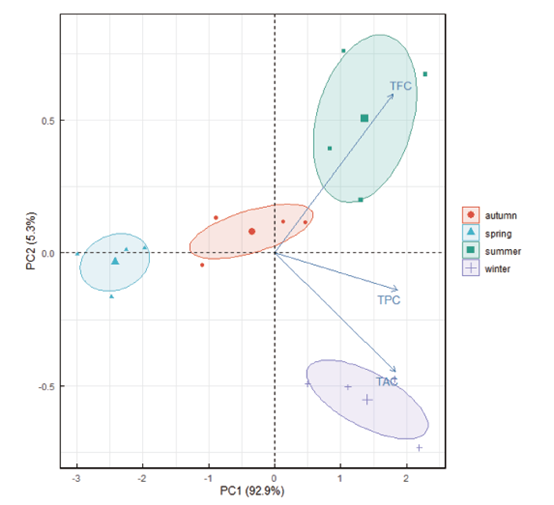
This study investigated how the cultivation season affects phenolic compounds and plant nutrient element composition in purple leafy sweet potato (Ipomoea batatas “CYY84–67”) grown under field conditions in Taiwan. Four seasonal plantings, representing spring, summer, autumn, and winter, were conducted from 2017 to 2018. Total phenolic content (TPC), total flavonoid content (TFC), and total anthocyanin content (TAC) were measured in leaves and stems at the first harvest of each season. Absolute contents per unit planting area were calculated by integrating compound concentrations, plant biomass, and planting density. Winter-grown plants showed significantly higher TPC, TFC, and TAC than plants grown in other seasons (P < 0.05), whereas relatively lower values were observed during summer and autumn. Across all seasons, leaves consistently contained higher levels of phenolic compounds than stems. On a per-area basis, winter leaf TPC, TFC, and TAC were approximately 4.9-, 5.6-, and 6.5-fold higher than those in stems, respectively. However, per- area accumulation reflects overall production performance and does not solely represent tissuelevel concentration. Canonical correlation analysis (CCorA) suggested that meteorological factors, particularly temperature and solar radiation-related variables, may be associated with seasonal variation in phenolic compound accumulation. Principal component analysis (PCA), used as an exploratory visualization tool rather than a direct statistical test of seasonal differences, illustrated seasonal separation patterns in leaf phenolic composition. In the PCA ordination, TPC and TAC tended to be associated with winter conditions, whereas TFC showed a closer association with summer conditions. Additional CCorA results, together with exploratory PCA visualization, suggested that plant nutrient element composition, particularly nitrogen, magnesium, and calcium, may be related to variation in phenolic compounds. Calcium content tended to be associated with winter conditions and TAC accumulation. Overall, these findings suggest that cultivation season, environmental conditions, and plant nutrient status may be associated with phenolic compound accumulation in purple leafy sweet potato. Given that this study was conducted over a single year across four cultivation seasons, further multi-year observations or controlled-environment experiments are required to validate these findings.
Key words:Purple leafy sweet potato, Cultivation season, Phenolic compounds, Plant nutrient element composition
Download: OTHER FORMAT Links
Taiwan Agricultural Research
 ISSN: 2790-086X
Vol. 75, No.3 (2026)
ISSN: 2790-086X
Vol. 75, No.3 (2026)
 Submit your manuscript
 Guide for authors
- 1. Effects of Fertilizer Application Rates on the Growth and Functional Components of Chrysanthemum morifolium (‘Taiwan Hangju No. 1’)
- 2. Biological Functions, Antioxidant Properties, and Environmental Regulation of Plant Phenolic Compounds
- 3. Comparative Study of Asparagus Cultivars under Greenhouse Conditions