Current issue
Author:Ya-Shiun Jan*
Abstract:
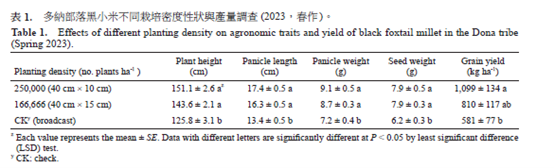
Black foxtail millet is an important traditional crop among the Dona tribe of Maolin District, Kaohsiung, Taiwan, where it serves not only as a staple food but also as a core grain in indigenous ritual culture. However, traditional broadcasting cultivation requires high labor input, results in unstable yield, and limits the sustainable production of this crop. This study evaluated the effects of plant spacing and sowing methods on agronomic traits, yield, working efficiency, production cost, and economic return of black foxtail millet, and assessed the feasibility of introducing smallscale machinery for drilling cultivation in mountainous tribal farming systems. The planting density experiment showed that 250,000 plants ha-1 (40 cm × 10 cm) produced the highest grain yield (1,099 kg ha-1), which was significantly higher than with wider spacing and traditional broadcasting. In the sowing method experiment, transplanting using paper plug seedlings produced the highest yield (1,029 kg ha-1), followed by mechanical drilling (946 kg ha-1), both of which were higher than broadcasting (771 kg ha-1). In terms of working efficiency, transplanting required the longest time (4 h per 0.1 ha), while drilling required 1.5 h and broadcasting required 1 h; however, the seed requirement was lowest in transplanting. Production cost analysis showed that drilling had the lowest cost, followed by transplanting, while broadcasting had the highest cost due to high labor requirements for manual weeding. Net return analysis indicated that drilling generated the highest profit (NT$216,100 ha-1), ten times more than that of broadcasting. These results indicate that proper plant spacing combined with drilling cultivation can improve yield while reducing labor and production costs. The introduction of small-scale mechanized drilling is suitable for mountainous tribal farming systems and can enhance production stability without disrupting traditional farming culture. This approach provides a practical strategy for the sustainable utilization and cultural preservation of indigenous millet in Taiwan.
Key words:Black foxtail millet, Drilling cultivation, Planting density, Mechanization, Indigenous crops
Download: OTHER FORMAT Links
Taiwan Agricultural Research
 ISSN: 2790-086X
Vol. 75, No.3 (2026)
ISSN: 2790-086X
Vol. 75, No.3 (2026)
 Submit your manuscript
 Guide for authors
- 1. Effects of Fertilizer Application Rates on the Growth and Functional Components of Chrysanthemum morifolium (‘Taiwan Hangju No. 1’)
- 2. Biological Functions, Antioxidant Properties, and Environmental Regulation of Plant Phenolic Compounds
- 3. Comparative Study of Asparagus Cultivars under Greenhouse Conditions