Current issue
Author:Ping-Lung Huang*
Abstract:
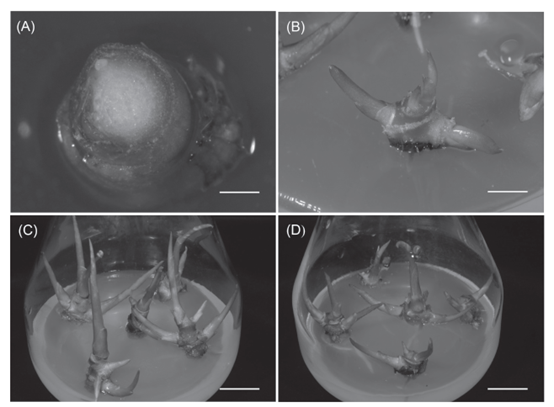
This study investigated the effects of different doses of p-chlorophenoxyisobutyric acid (PCIB) and 2,3,5-triiodobenzoic acid (TIBA) on the induction of Aglaonema ‘Lady Valentine’ lateral buds and regenerated adventitious buds, as well as shoot elongation, to overcome difficulties with new bud growth in micropropagation. Results clearly show that the 1/3 Murashige and Skoog inorganic salts (1/3MS) basal medium supplemented with PCIB and TIBA cannot promote the propagation of secondary lateral buds, callus formation, or bud regeneration. Compared to TIBA, supplementing 1 mg L-1 PCIB into the medium can effectively increase the average length of lateral buds and stimulate an increase of approximately 2.34 cm in the elongation of lateral shoots after six weeks of culture. Similarly, when regenerated adventitious buds are first cultured on a basal medium containing 3.0 mg L-1 of 6-benzyladenine (BA) for a short period and subsequently excised and transferred to a 1/3MS medium supplemented with 1 mg L-1 of PCIB, normal shoot development and rooting can be successfully promoted. These buds can develop into regular plantlets, grow roots, and be transplanted to ex vitro cultivation without requiring acclimatization. Using this method, the industrial value of large-scale propagation can be realized. However, using the shoot elongation phase, TIBA is not suitable.
Key words:Adventitious shoot, Anti-auxin, Shoot elongation, Organogenic callus
Download: OTHER FORMAT Links
Taiwan Agricultural Research
 ISSN: 2790-086X
Vol. 75, No.3 (2026)
ISSN: 2790-086X
Vol. 75, No.3 (2026)
 Submit your manuscript
 Guide for authors
- 1. Effects of Fertilizer Application Rates on the Growth and Functional Components of Chrysanthemum morifolium (‘Taiwan Hangju No. 1’)
- 2. Biological Functions, Antioxidant Properties, and Environmental Regulation of Plant Phenolic Compounds
- 3. Comparative Study of Asparagus Cultivars under Greenhouse Conditions