Current issue
Author:Tzu-Huan Hung、Ting-Wei Chiu、Chia-Hui Tang、Fu-Bon Shih、Chia-Jen Liu、Feng-Chyi Lin、Shu-Fen Chang*
Abstract:
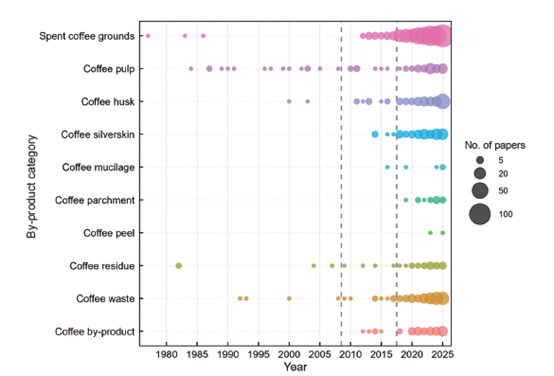
This study presents a scientometric analysis of global coffee by-product research from 1977 to 2025, using 1,195 unique publications to elucidate the field’s evolution from waste management to biorefinery applications. Driven by the United Nations Sustainable Development Goals and corporate Environmental, Social, and Governance mandates, research on related topics has exhibited exponential growth since 2018, with spent coffee grounds (SCG) receiving the most attention (657 publications). A cross-comparison of geography and raw materials reveals a distinct dual-track pattern: consuming nations (e.g., Italy, South Korea, Spain) dominate SCG research, while producing nations (e.g., Brazil, India) prioritize upstream by-products (pulp, husk), reflecting a feedstockoriented research tendency. Keyword co-occurrence analysis identified five major research clusters: circular bioeconomy frameworks, thermochemical conversion, bioplastics, agronomic recycling, and bioactive substance recovery. These clusters demonstrate technological divergence based on feedstock characteristics: SCG is closely linked to biofuels and carbon materials, whereas upstream by-products such as pulp, focus on bioactive recovery and agronomic recycling. Thematic evolution analysis further indicates a paradigm shift from early waste management to complex circular bioeconomy architecture. Consequently, this study proposes a “Dual-Track” model for future development, where producers and consumers strengthen industrial and commercial integration within their respective supply chains. Specifically, the producer end should focus on specialized networks to maximize nutritional recovery and agricultural value, while the consumer end targets advanced materials and circular energy industries. This location-adaptive framework provides a strategic roadmap for building a resilient global coffee bioeconomy.
Key words:Coffee by-products, Scientometric analysis, Biorefinery, Circular bioeconomy, Spent coffee grounds
Download: OTHER FORMAT Links
Taiwan Agricultural Research
 ISSN: 2790-086X
Vol. 75, No.3 (2026)
ISSN: 2790-086X
Vol. 75, No.3 (2026)
 Submit your manuscript
 Guide for authors
- 1. Effects of Fertilizer Application Rates on the Growth and Functional Components of Chrysanthemum morifolium (‘Taiwan Hangju No. 1’)
- 2. Biological Functions, Antioxidant Properties, and Environmental Regulation of Plant Phenolic Compounds
- 3. Comparative Study of Asparagus Cultivars under Greenhouse Conditions