Current issue
Author:Shuen-Chi You、Yuan-Kai Tu、Pei-Hsuan Wu、Pei-Ying Huang、 Wei-Ting Tsai、Ching Chuang、Chi-Ni Hsia*
Abstract:
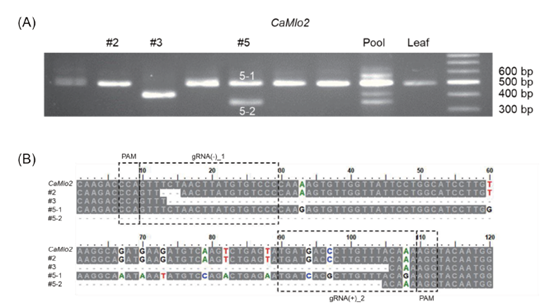
Solanaceous species include many globally significant nutritional and food crops. To accelerate variety improvement, this study aimed to establish a rapid platform for evaluating the efficiency of a DNA-free gene-editing system using a single-protoplast-based approach. Using the tomato cultivar ‘Tainan-AVRDC No. 6’ and the chili pepper cultivar ‘Cheng-la’ as experimental materials, we first compared the protoplast isolation efficiency from axenic seedling leaves of different weights under consistent enzymatic conditions. Dual guide RNAs (dual gRNAs) were designed to target the susceptibility genes SlDMR6 in tomato and CaMlo2 in pepper. CRISPR/Cas9 ribonucleoproteins (RNPs) were directly delivered into protoplasts via PEG-mediated transformation. Subsequently, the gene-editing efficiency of the CRISPR/Cas9 RNPs was evaluated at the single-protoplast level using a PCR-based analysis platform. The results indicated that the efficiency of target fragment deletions was 33.3% in tomato protoplasts and 19.2% in pepper protoplasts. Further validation via Sanger sequencing confirmed a 154-bp (base pair) deletion in the tomato target gene. In contrast, sequencing results for the pepper target gene showed diversity, including various editing patterns such as fragment deletions and base substitutions. This study demonstrates that a rapid evaluation system using a single-protoplast-based platform can significantly shorten the time required for preliminary efficacy testing of CRISPR/Cas9 RNPs, providing a faster and more precise evaluation method for the implementation of New Breeding Techniques (NBTs).
Key words:Protoplast, Gene editing, CRISPR/Cas9 RNP, Dual gRNA
Download: OTHER FORMAT Links
Taiwan Agricultural Research
 ISSN: 2790-086X
Vol. 75, No.3 (2026)
ISSN: 2790-086X
Vol. 75, No.3 (2026)
 Submit your manuscript
 Guide for authors
- 1. Effects of Fertilizer Application Rates on the Growth and Functional Components of Chrysanthemum morifolium (‘Taiwan Hangju No. 1’)
- 2. Biological Functions, Antioxidant Properties, and Environmental Regulation of Plant Phenolic Compounds
- 3. Comparative Study of Asparagus Cultivars under Greenhouse Conditions