Current issue
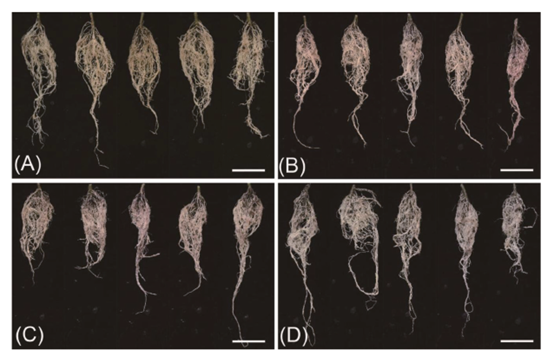
Author:Jiunn-Feng Su、Ling-Yen Li、Lan-Yi Chien、Ting-Fang Hsieh*
Abstract:
The effects of a 36% cinnamaldehyde microemulsion (Plant Protection Registration No. 00823; trade name Black Asura MC) and its derived granules on root-knot formation caused by the southern root-knot nematode (Meloidogyne incognita) on tomato roots were evaluated under pot conditions. The microemulsion was first applied to tomato plants 7 d prior to nematode inoculation, and rootknot formation was assessed 5 wk after inoculation. Across two repeated trials, reductions in rootknot incidence were achieved when the microemulsion was drenched at a 5,000-fold dilution, with the rate of galling decreased from 100% and 69.7% to 50.8% and 30.5%, respectively. The root-knot index (0–4) decreased from 4.0 to 3.4 and from 4.0 to 2.3, respectively, indicating a stable inhibitory effect. When the microemulsion was applied 7 d after nematode inoculation, suppression of the rootknot galling rate was not effective. The influence of application methods of the cinnamaldehyde granules on tomato root-knot development was also assessed. When the granules were mixed with half of the growth substrate, in the first trial, treatment with 100 mg pot-1 reduced the galling rate from 60.8% to 39.4% and decreased the gall index from 3.8 to 2.8, showing the best effect. In the second trial, treatment with 200 mg pot-1 reduced the galling rate from 82.0% to 53.6% and decreased the gall index from 4.0 to 3.6, showing the best effect. When different application methods were compared, significant reductions in both the root-knot rate galling rate and the root-knot index were achieved with surface spreading at 50, 100, and 200 mg pot-1. In contrast, the uniformly mixed treatments exhibited a limited suppressive effect, and mixing at 200 mg pot-1 resulted in obvious inhibition of root development.
Key words:Cinnamaldehyde microemulsion, Cinnamaldehyde granules, Southern root-knot nematode, Root-knot index
Download: OTHER FORMAT Links
Taiwan Agricultural Research
 ISSN: 2790-086X
Vol. 75, No.3 (2026)
ISSN: 2790-086X
Vol. 75, No.3 (2026)
 Submit your manuscript
 Guide for authors
- 1. Effects of Fertilizer Application Rates on the Growth and Functional Components of Chrysanthemum morifolium (‘Taiwan Hangju No. 1’)
- 2. Biological Functions, Antioxidant Properties, and Environmental Regulation of Plant Phenolic Compounds
- 3. Comparative Study of Asparagus Cultivars under Greenhouse Conditions