Current issue
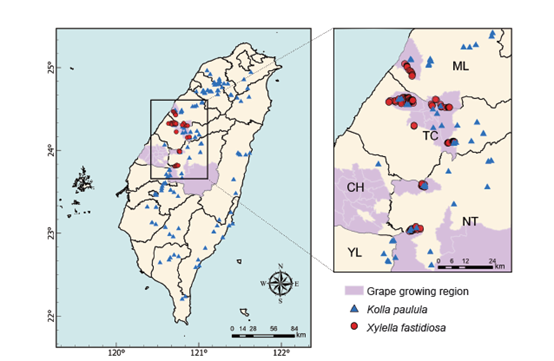
Author:Wan-Hsiu Yang、Hsien-Tzung Shih、Chiou-Chu Su、Yu-Han Chen、Yaw-Jen Dong、Chung-Jan Chang、Li-Hsin Wu*
Abstract:
Climate change impacts the potential distribution of agricultural pests and pathogens. In this study, maximum entropy (MaxEnt) modeling was used to predict suitable habitats for the bacterium Xylella fastidiosa and its vector Kolla paulula in Taiwan under climate change scenarios. Bioclimatic variables were selected based on the occurrence data of both species using environmental niche factor analysis. The modeling results suggest that X. fastidiosa shows high climatic suitability in northwest Nantou, west Taichung, and southwest Miaoli, while K. paulula is mainly distributed in lowaltitude mountainous regions of Taiwan. The analysis of climatic factors suggests that temperature and precipitation are the principal factors in determining suitable habitats for both X. fastidiosa and K. paulula. Regarding the future distribution patterns under the CMIP6 GCM (BCC-CSM2-MR) and 4 shared socioeconomic pathways (SSPs) climate change scenarios, there are no significant differences across varying carbon emissions. The distribution patterns of both species showed only a slight northward shift, with no major significant changes. This study provides the first highresolution assessment of the potential distribution of Pierce’s disease in the Asian region, offering a valuable reference for other Asian nations. Furthermore, by integrating the distribution patterns of the pathogen and its insect vector, the findings provide a comprehensive basis for future pest and disease management strategies.
Key words:MaxEnt modeling, Climate change, Xylella fastidiosa, Kolla paulula, Pierce’s disease
Download: OTHER FORMAT Links
Taiwan Agricultural Research
 ISSN: 2790-086X
Vol. 75, No.3 (2026)
ISSN: 2790-086X
Vol. 75, No.3 (2026)
 Submit your manuscript
 Guide for authors
- 1. Effects of Fertilizer Application Rates on the Growth and Functional Components of Chrysanthemum morifolium (‘Taiwan Hangju No. 1’)
- 2. Biological Functions, Antioxidant Properties, and Environmental Regulation of Plant Phenolic Compounds
- 3. Comparative Study of Asparagus Cultivars under Greenhouse Conditions