Current issue
Author:Chao-Yang Kao*、Yu-Ping Liang
Abstract:
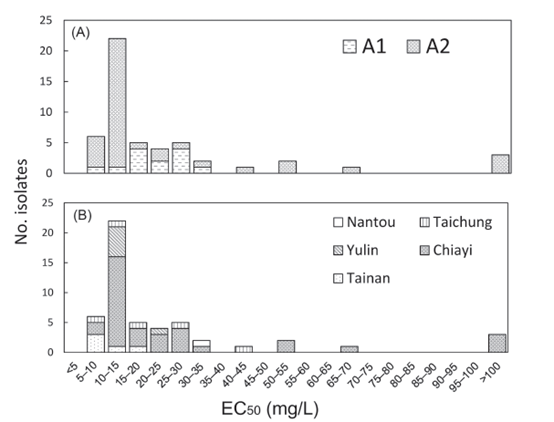
Phytophthora root rot (PRR) caused by Phytophthora cinnamomi is the most important disease of avocado worldwide. Phosphonate fungicides have been applied to manage this disease for decades in many countries. However, phosphite use has increased tolerance to phosphite in P. cinnamomi isolates. This study aimed to investigate the phosphite sensitivity of P. cinnamomi isolates collected from different avocado orchards in Taiwan. A total of 51 P. cinnamomi isolates were obtained from 18 avocado orchards located in Taichung, Nantou, Yunlin, Chiayi, and Tainan. The in vitro sensitivity of mycelial growth to phosphite was measured on 5% V8 agar at different phosphite concentrations, and the effective concentration to reduce growth by 50% (EC50) values were determined. Most isolates were sensitive to phosphite, with 22 isolates exhibiting EC50 values ranging from 10 to 15 mg L-1. Seven isolates showed tolerance to phosphite, with EC50 values ranging from 41 to 67 mg L-1. Moreover, three isolates obtained from Chiayi City had EC50 values exceeding 100 mg L-1, indicating the presence of highly resistant isolates in that region. Analysis of mating types revealed that A2 isolates displayed a wider range of EC50 values. The regional analysis revealed that both mating types and tolerant isolates (EC50 > 35 mg L-1) were present in orchards in Taichung and Chiayi, indicating a potential risk of the dissemination of resistant isolates via sexual reproduction. The results of this study will provide essential information for developing effective and sustainable phosphite management strategies against avocado root rot in Taiwan.
Key words:Avocado, Root rot, Phytophthora cinnamomic
Download: OTHER FORMAT Links
Taiwan Agricultural Research
 ISSN: 2790-086X
Vol. 75, No.3 (2026)
ISSN: 2790-086X
Vol. 75, No.3 (2026)
 Submit your manuscript
 Guide for authors
- 1. Effects of Fertilizer Application Rates on the Growth and Functional Components of Chrysanthemum morifolium (‘Taiwan Hangju No. 1’)
- 2. Biological Functions, Antioxidant Properties, and Environmental Regulation of Plant Phenolic Compounds
- 3. Comparative Study of Asparagus Cultivars under Greenhouse Conditions