All issues
Author:Guang-Jauh Shieh
Abstract:
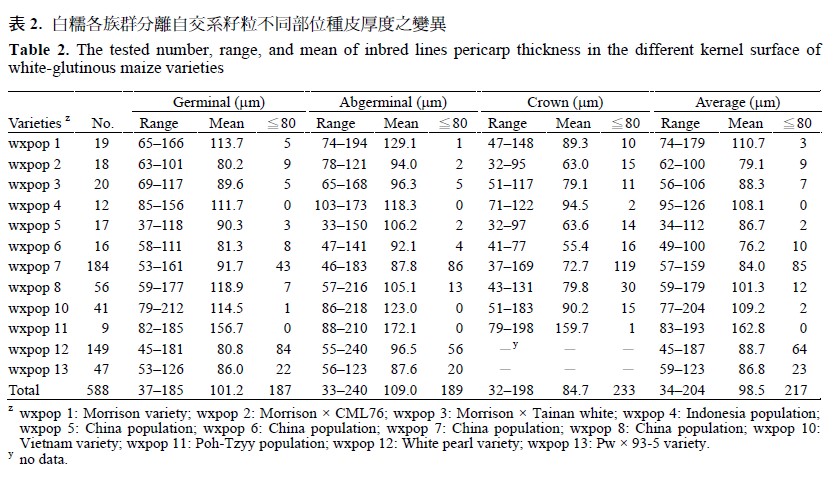
Glutinous corn (Zea mays) is a popular fresh eating food in Taiwan. This study was conducted to determine difference of pericarp thickness in inbred lines of purple glutinous corn and white glutinous corns. Nineteen purple glutinous corn and 12 white glutinous corns were grown in a field at the Taiwan Agricultural Research Institute, Wufeng, Taichung in 2006. Physiologically matured inbred seeds produced by sibling, including 390 inbred lines from 19 purple glutinous corn and 588 inbred lines 12 white glutinous corn, were harvested and used in the study of pericarp thickness. Results showed significant differences (p < 0.05) in the thickness of pericarp among the inbred lines tested. Also, the thickness of pericarp varied with the area of a kernel, thin at the crown, but increase in thickness at the germinal side and abgerminal. In the purple glutinous corn, the inbred lines from varities of PF, PG, PH, PJ, PL, and PN had the trait of thin pericarp, and produced more lines with thin pericarp (< 60 μm) but the inbred lines from the varities of PC, PE, PI, PQ, PR, and PS had thicker pericarp. In the white glutinous corn, the inbred line the from the varities of wxpop 2, wxpop 3, wxpop 5, wxpop 6, wxpop 7, wxpop 12, and wxpop 13 had thin pericarp, and produced more inbred lines with pericarp thinner than 80 μm. In general, the pericarp of purple glutinous corn thinner than the pericarp of white glutinous corn. The wide range of variation of pericarp thickness suggests that some of the inbred lines are potential for varietal improvement of glutinous corn.
Key words:Maize, Glutinous corn, Pericarp thickness, Variation
Download: PDF Links
Taiwan Agricultural Research
 ISSN: 2790-086X
Vol. 75, No.1 (2026)
ISSN: 2790-086X
Vol. 75, No.1 (2026)
 Submit your manuscript
 Guide for authors
- 1. Challenges for Sustainable Pest Management Utilizing Indigenous Natural Enemies in Chrysanthemum Fields in Okinawa
- 2. Integrated Pest Management Strategies for Strawberry Production in Taiwan: A Review of Technological Innovations and Implementation Challenges
- 3. Agricultural Drones, a Modern Tool for Agricultural Multi-applications and Future Perspectives