All issues
Author:Lindsey Price Burbank* and Angel Guerrero
Abstract:
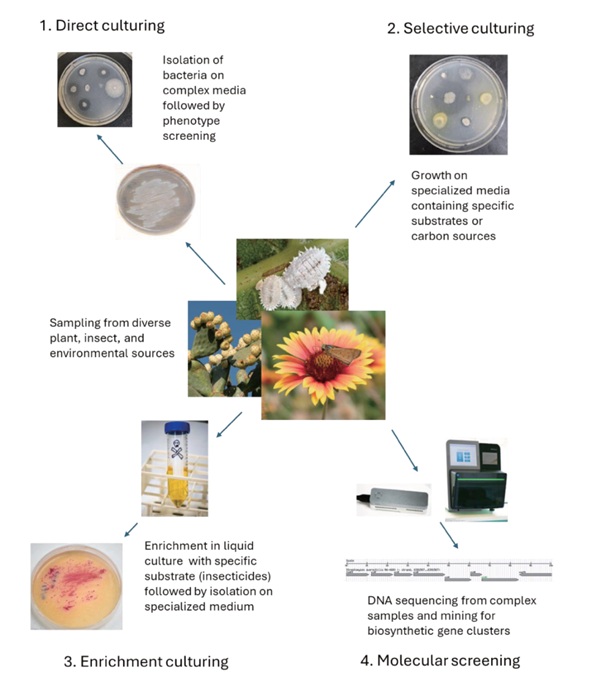
Insect pests have plagued agriculture throughout history, and management of crop pests requires continuous innovation. Bacteria and other microbes are important tools for insect pest control through pathogenic activity, production of toxic secondary metabolites, and promotion of plant defenses. Additionally, bacteria present in agricultural environments often possess the ability to metabolize agricultural chemicals and can therefore be used to mitigate environmental impacts of agriculture. Only a small percentage of bacteria from plant and insect sources have been studied however, while there is a wealth of microbial diversity that is still unused. As the need for agricultural productivity increases and climate change shifts patterns of pest and disease, it is important to explore a wider range of bacterial species with potential for biological pest control and bioremediation applications. This review outlines some of the history of bacterial biological control, use of bacteria-derived agrochemicals, bacteria-mediated insecticide resistance, and current understanding of bacteria-insect-plant interactions. Suggestions are also provided for further research in this area to broaden the range of sustainable pest control options.
Key words:Insecticides, Biological control, Agriculture, Beneficial bacteria, Pest management
Download: PDF Links
Taiwan Agricultural Research
 ISSN: 2790-086X
Vol. 74, No.4 (2025)
ISSN: 2790-086X
Vol. 74, No.4 (2025)
 Submit your manuscript
 Guide for authors
- 1. Bacteria in Insect Pest Management in Agriculture: The Past, Present, and Future
- 2. Multiple Applications of Yellow Mealworm (Tenebrio molitor L.) Reared on Plant-Based Substrates: Circular Agriculture, Farmed Animal Feed, and Other High-Value Products
- 3. Mini-Review on Microbial Pesticide Research for Crop Protection Assisted by Generative AI