All issues
Author:Meng-You Hsieh*, Wen-Bin Feng*, Pei-Chen Hsu, Yaw-Jen Dong, Ya-Lin Lee, and Hsien-Tzung Shih
Abstract:
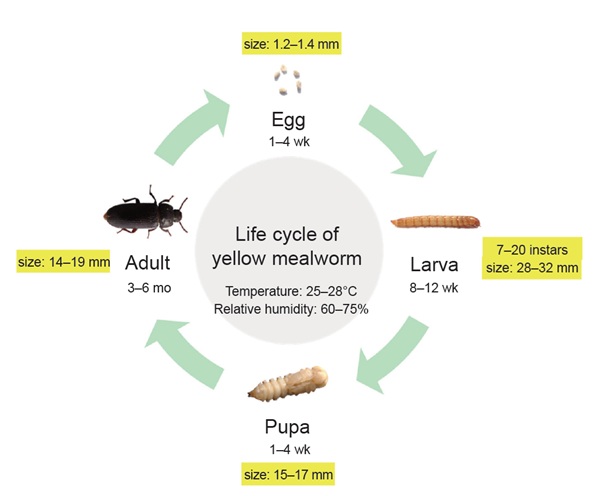
With the continuous growth of the global population, pressures on food supply and challenges in agricultural waste management have become increasingly severe. Insects have been increasingly recognized as a key solution to these issues. As biological agents capable of converting organic waste, insects can transform agricultural by-products and food processing residues (resources that are otherwise difficult to be used) into valuable outputs. This process not only promotes resource recycling and reduces the carbon footprint but also offers a sustainable alternative to conventional protein sources in animal feed, such as soybean meal and fishmeal, thereby supporting the sustainable development of both agriculture and animal husbandry. In the application of insects as feed ingredients for farmed animals, they provide high levels of protein and fat, making them a promising substitute for conventional animal feed components. Their cultivation requires fewer resources, has a short production cycle, and demands less space compared to traditional livestock, which positions insect farming as an efficient and environmentally friendly model in resource utilization. In addition to larval biomass, insect frass, the excreta and residual substrate generated during yellow mealworm rearing, constitutes an important by-product. Rich in nitrogen, phosphorus, chitin, and beneficial microorganisms, frass has shown potential as an organic fertilizer that enhances plant growth. Its application further reinforces the role of mealworm farming in sustainable waste recycling systems. This study takes the yellow mealworm (Tenebrio molitor) as a case study to explore its feasibility and advantages in decomposing plantbased residual materials and analyzes key considerations in its breeding process. In addition, this study assesses the potential of yellow mealworm larvae as a raw material in animal feed, including its nutritional value and practical application cases. It also reviews the prospects of using insect biomass and by-products in the development of high-value end products. The aim of this research is to provide a comprehensive understanding of the impact of resource insects on global food supply and environmental sustainability. Compared to traditional crop and livestock farming, insect farming exhibits higher efficiency in resource utilization and significantly lower environmental impact, making it one of the green industries aligned with the United Nations Sustainable Development Goals (SDGs).
Key words:Tenebrio molitor, Plant-based substrates, Circular agriculture, Farmed animal feed, High-value applications
Download: PDF Links
Taiwan Agricultural Research
 ISSN: 2790-086X
Vol. 74, No.4 (2025)
ISSN: 2790-086X
Vol. 74, No.4 (2025)
 Submit your manuscript
 Guide for authors
- 1. Bacteria in Insect Pest Management in Agriculture: The Past, Present, and Future
- 2. Multiple Applications of Yellow Mealworm (Tenebrio molitor L.) Reared on Plant-Based Substrates: Circular Agriculture, Farmed Animal Feed, and Other High-Value Products
- 3. Mini-Review on Microbial Pesticide Research for Crop Protection Assisted by Generative AI