All issues
Author:Chao-Jung Wu*, Sui-Li Hsu, and Su-Yu Lai
Abstract:
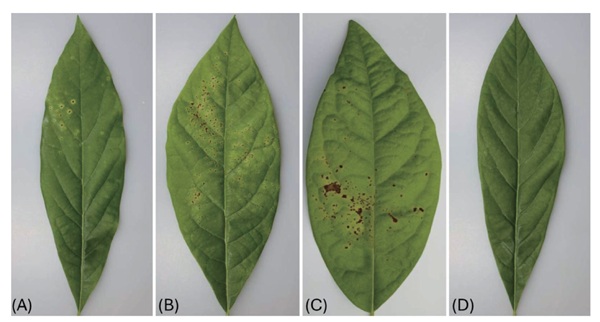
Avocado leaf spot disease, caused by Pseudoplagiostoma perseae, is increasingly observed in avocado orchards across Taiwan. Despite its prevalence, limited information is available on disease dynamics and effective control measures. Field surveys conducted in this study revealed that disease severity peaks during the fall and winter, with disease decline occurring in spring. Laboratory assays showed that the optimal temperature for mycelial growth is 25℃, while the optimal temperature for spore germination ranges from 20℃ to 30℃. Pathogenicity tests confirmed that P. perseae induces characteristic pinpoint-like spots with yellow halos on the leaves of avocado cultivars ‘Hass’, ‘Pinkerton’, and ‘Tainung No.1 Tasty Red’ within 2 wk post-inoculation. Among the fungicides tested at 1 mg a.i. L-1, pyraclostrobin completely inhibited mycelial growth. In addition, azoxystrobin, pyraclostrobin, trifloxystrobin, azoxystrobin + difenoconazole, fluopyram + trifloxystrobin, thiabendazole, and fluazinam completely suppressed spore germination at 1 mg a.i. L-1. These findings contribute to a better understanding of the epidemiology of P. perseae and provide guidance for the development of effective disease management strategies in avocado cultivation.
Key words:Avocado, Leaf spot, Pathogenicity, Temperature, Fungicide
Download: PDF Links
Taiwan Agricultural Research
 ISSN: 2790-086X
Vol. 74, No.4 (2025)
ISSN: 2790-086X
Vol. 74, No.4 (2025)
 Submit your manuscript
 Guide for authors
- 1. Bacteria in Insect Pest Management in Agriculture: The Past, Present, and Future
- 2. Multiple Applications of Yellow Mealworm (Tenebrio molitor L.) Reared on Plant-Based Substrates: Circular Agriculture, Farmed Animal Feed, and Other High-Value Products
- 3. Mini-Review on Microbial Pesticide Research for Crop Protection Assisted by Generative AI