All issues
Author:Chu-Ping Lin, Min-Chi Hsu, Jyh-Nong Tsai, Jun-Wei Fan, and Jin-Hsing Huang*
Abstract:
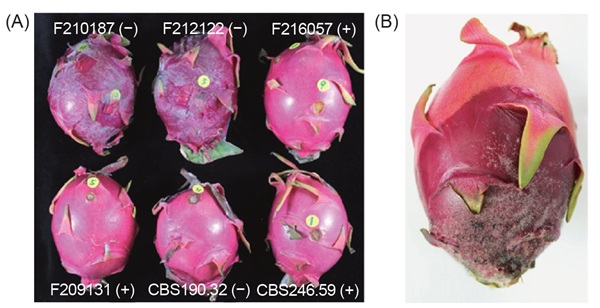
Wet rot of pitaya, caused by Gilbertella persicaria, is a significant disease affecting pitaya production in Taiwan. However, the biological characteristics and pathogenicity of the pathogen remain unknown. From 2009 to 2024, diseased pitaya tissues showing symptoms of wet rot were collected from 90 field sites across 23 townships in 11 counties, as well as from one local market in Taiwan. A total of 212 isolates of G. persicaria were obtained from pitaya, all of which belonged to the minus (-) mating type. Additionally, one isolate of G. persicaria from a diseased strawberry and another from a peach were both identified as the plus (+) mating type. These results indicate that both mating types of G. persicaria are present in Taiwan. To further investigate host-related differences among G. persicaria isolates, morphological, pathogenicity, and molecular phylogenetic analyses were conducted. The results showed that: (1) Morphologically, the number of sporangial wall segments in pitaya isolates was significantly higher than that of the type strain, by an average of 2.1–2.6 segments; (2) In pathogenicity assays, only pitaya isolates were able to induce typical wet rot symptoms on pitaya fruits. The results indicated that symptom type and lesion size were associated with the host origin of G. persicaria isolates, but not with their mating type; (3) In phylogenetic analysis, the phylogenetic tree based on concatenated sequences of internal transcribed spacer (ITS), actin, and 28S rDNA large subunit revealed that pitaya isolates formed a distinct monophyletic clade. Based on morphology, pathogenicity, and phylogenetic analyses, the pitaya isolates of G. persicaria were different from the type strain. Environmental condition assays indicated that optimal temperature and relative humidity range for disease development are 28–36℃ and above 80%. No disease symptoms developed at temperatures below 16℃ or above 40℃. Further inoculation trials were conducted on pitaya fruits at various developmental stages, followed by postharvest incubation at 25–32℃ to observe disease progression. These results demonstrated that fruits exhibited the most severe disease by postharvest inoculation, indicating that G. persicaria primarily infects pitaya during the fruit maturation stage, particularly at harvest.
Key words:Sporangial wall segment, Mating type, Pathogenicity, Phylogeny, Infection timing
Download: PDF Links
Taiwan Agricultural Research
 ISSN: 2790-086X
Vol. 74, No.4 (2025)
ISSN: 2790-086X
Vol. 74, No.4 (2025)
 Submit your manuscript
 Guide for authors
- 1. Bacteria in Insect Pest Management in Agriculture: The Past, Present, and Future
- 2. Multiple Applications of Yellow Mealworm (Tenebrio molitor L.) Reared on Plant-Based Substrates: Circular Agriculture, Farmed Animal Feed, and Other High-Value Products
- 3. Mini-Review on Microbial Pesticide Research for Crop Protection Assisted by Generative AI