All issues
Author:Chi-Ni Hsia, Hsin-Yi Tseng, Yi-Heng Tsai, Wei-Ting Tsai, Ching Chuang, and Shuen-Chi You*
Abstract:
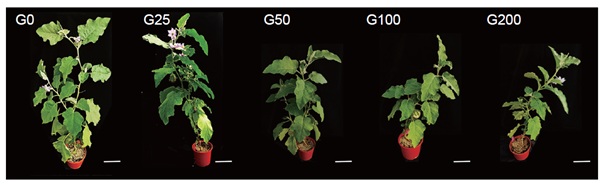
Eggplant (Solanum melongena L.) is an important vegetable and a core collection of the National Plant Genetic Resources Center in Taiwan. Seeds of eggplant with a low germination rate (1%) in the seed bank stock were used in this study. Effects of immersion duration (8, 16, and 24 h), hot water treatment (55℃ for 15 min), and culture temperature (27℃ for 24 h, and 30℃ for 16 h/20℃ for 8 h) on seed germination were investigated utilizing the paper germination method. Results showed that among the three factors, only immersion duration significantly increased the seed germination 2 wk after sowing, and the highest germination rate of 4.0% was obtained with immersion for 16 h with variable temperature culture (30℃/20℃, 16 h/8 h). The above-mentioned ungerminated seeds 2 wk after sowing were transplanted into a 1/2 MS medium (Murashige and Skoog medium) supplemented with 0–200 mg L-1 GA3 and consistently cultured under the same temperature conditions, which were either constant 27℃ or variable temperature conditions. The results showed that 1/2 MS culture medium without GA3 had a 12.5% germination rate after 3 wk of culture. Furthermore, an increased germination rate of 25.0% was achieved by combining 1/2 MS culture medium with 100 mg L-1 GA3 and cultured in variable temperature conditions. Treatments in combination with MS basal salt concentration (0, 1/2, and 1 strength) and GA3 concentration (0 and 50 mg L-1) in the sowing culture solution were tested successively. Although the results showed that the two factors had no significant effect on seed germination (based on radicle protrusion 2 mm), enhanced shoot germination rates were observed on the treatments with either 1/2 MS or 50 mg L-1 GA3 alone.
Key words:Solanum melongena L., Seed, Germination, Gibberellic acid, MS medium
Download: PDF Links
Taiwan Agricultural Research
 ISSN: 2790-086X
Vol. 74, No.4 (2025)
ISSN: 2790-086X
Vol. 74, No.4 (2025)
 Submit your manuscript
 Guide for authors
- 1. Bacteria in Insect Pest Management in Agriculture: The Past, Present, and Future
- 2. Multiple Applications of Yellow Mealworm (Tenebrio molitor L.) Reared on Plant-Based Substrates: Circular Agriculture, Farmed Animal Feed, and Other High-Value Products
- 3. Mini-Review on Microbial Pesticide Research for Crop Protection Assisted by Generative AI